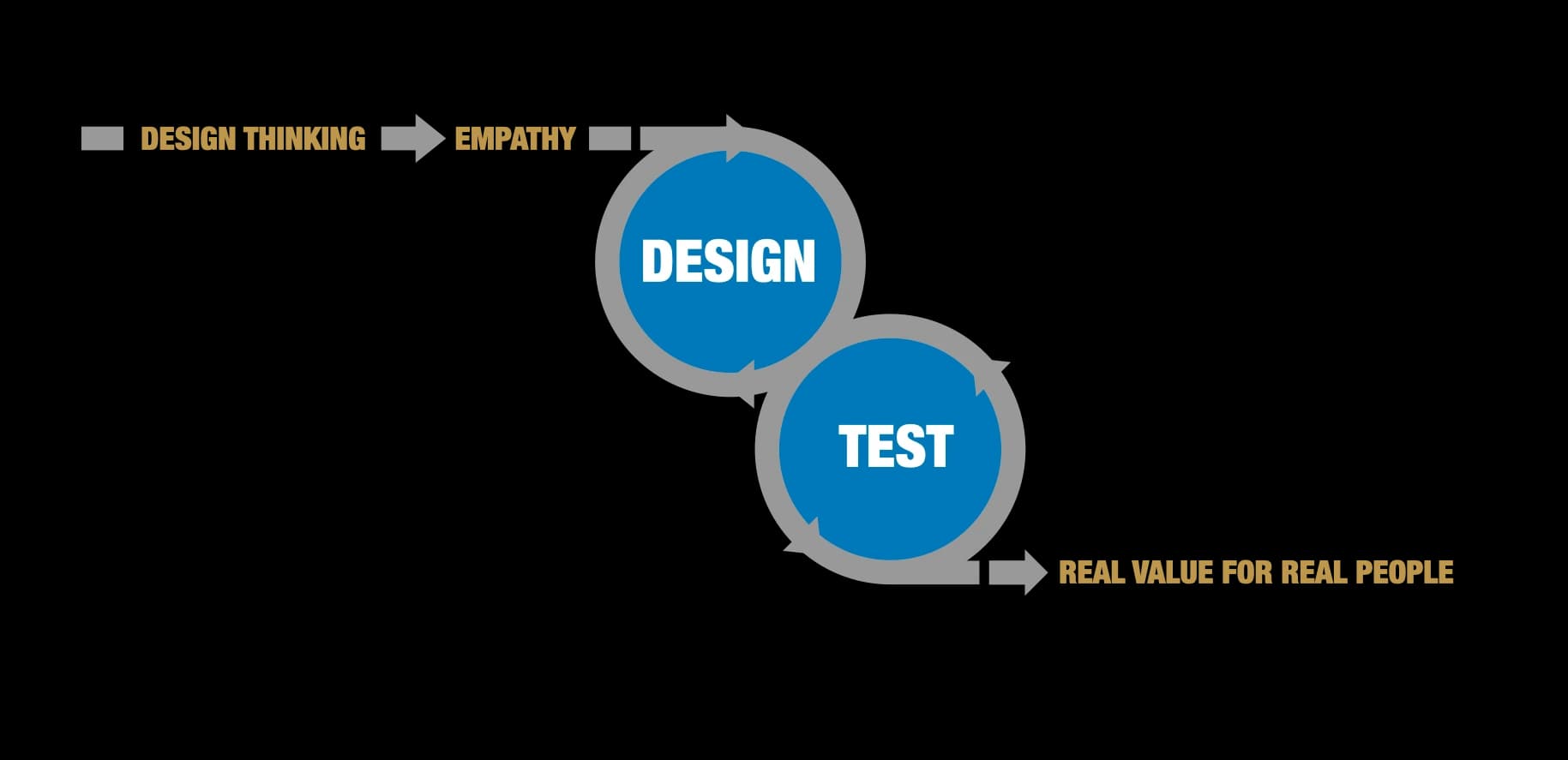
Most strategy decks are written for the person presenting them, not the people living them. They're dense, linear, and built to impress in a boardroom — not to guide a team through ambiguity on a Tuesday afternoon.
After nearly two decades of building digital products, I've come to believe that strategy deserves the same human-centered design thinking we apply to the products themselves.
Strategy is a Product
Think about what makes a great product:
- It solves a real problem for a real person
- It's easy to understand and act on
- It evolves based on feedback
- It has a clear job to be done
Now ask yourself: does your current strategy do any of those things?
Most don't. They answer the what but not the why. They set direction but don't equip the people who have to execute it.
Start with the User of the Strategy
Before writing a single word, ask: who actually uses this strategy day-to-day?
It's not the executive team. It's the engineer deciding whether to take on tech debt. The designer choosing between two directions. The PM writing the next sprint goal. The CS rep answering an edge case.
When I reframe strategy as a product, I start with those people. I run stakeholder interviews the same way I'd run user research. I ask:
- What decisions do you make most often that feel unclear?
- When do you feel like you're guessing at what leadership wants?
- What information would help you move faster?
The answers consistently reveal that teams don't lack ambition — they lack clarity. They need a strategy that answers the question: "When I'm not sure what to do, what should guide me?"
Clarity Over Comprehensiveness
The instinct when writing strategy is to cover everything. Don't.
A strategy that tries to address every scenario ends up guiding none of them. The best strategies I've seen are ruthlessly focused. They make three or four choices that are hard to make — and explicit about what they won't do.
"Strategy is as much about what you stop doing as what you start."
When we built the product strategy for Bowflex JRNY, we could have tried to be everything to everyone. Instead, we made a hard call: we were building for the person who bought a Bowflex and never used it. Not the fitness enthusiast. Not the casual walker. The lapsed buyer who felt guilty about the machine in their basement.
That single clarity unlocked six months of roadmap decisions. It meant we prioritized motivation and habit formation over raw feature breadth. It meant our UX was warm and encouraging, not clinical and data-heavy. Every question we faced — we had an answer.
Make it Living
Static strategy is dead strategy.
I now treat every major strategy artifact like a living document — not a quarterly deck. It lives in Notion or Confluence, versioned and linked. It has an owner. It gets reviewed when the market moves, not just when the fiscal year ends.
More importantly: it has a feedback loop. I ask teams to flag moments where the strategy felt unhelpful, or where they had to override it. Those flags are the most valuable product feedback I receive.
The Test
Here's the test I apply to every strategy before it goes out:
Could a new team member, on their first week, read this and make a good decision without asking anyone?
If the answer is no — keep simplifying.
The goal isn't a perfect document. It's a shared mental model that travels without you.