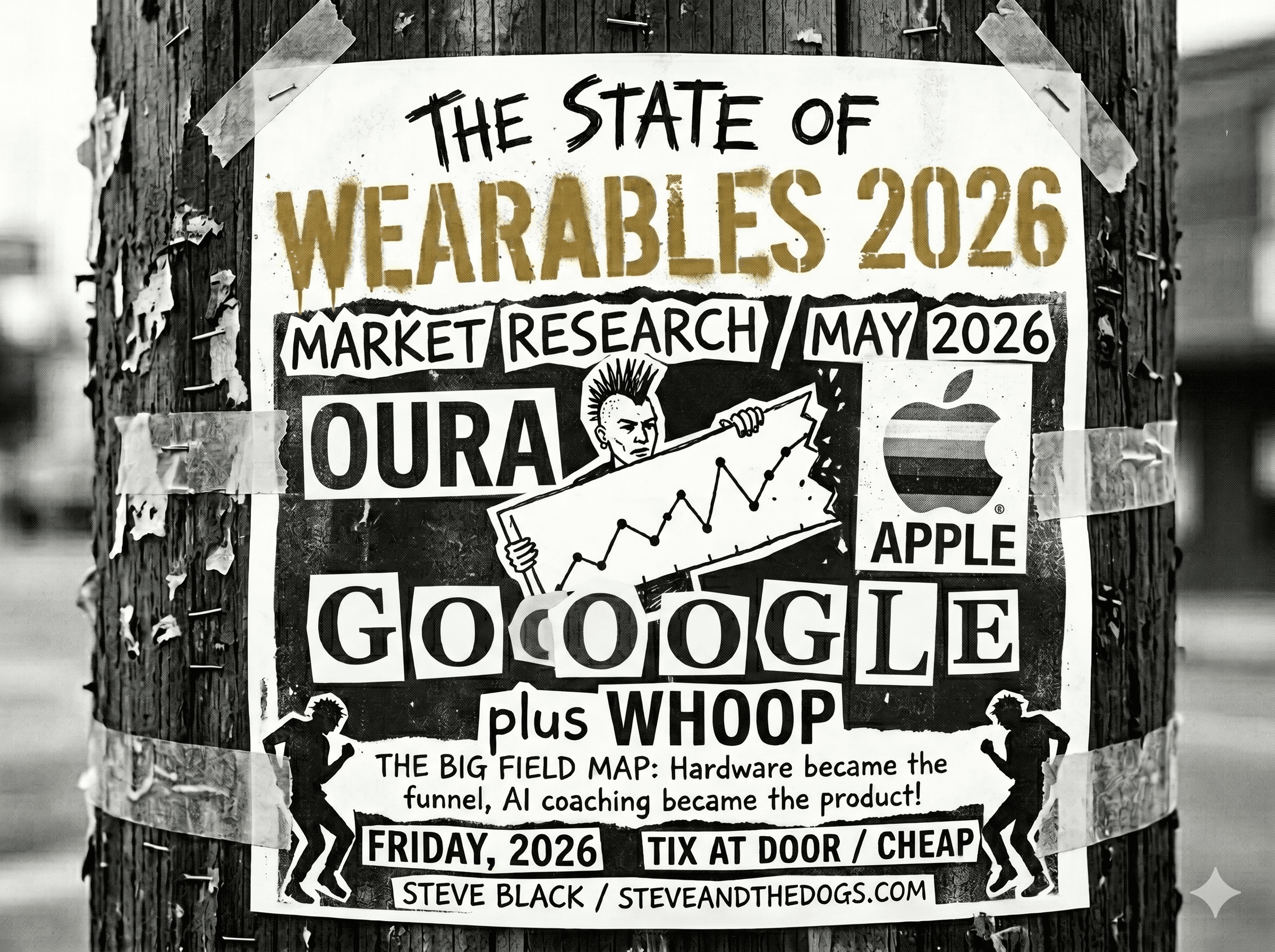
The State of Wearables, 2026
Hardware became the funnel. AI coaching and subscription value became the product. A field map of every device that matters — who's playing where, how we got here, and what makes someone wear it again the next day.
What's actually happening, right now.
A live feed of the announcements shaping the next chapter. Newest first. Last updated May 28, 2026.
Oura Ring 5 — the world's smallest smart ring.
40% smaller than Gen 4 (6.09mm wide vs. 7.99mm, 2.28mm thick vs. 2.88mm). Adds Blood Pressure Signals and Nighttime Breathing under a new "Health Radar" framework. Hypertension and sleep apnea detection now on a ring. $399 starting (Silver/Black), $499 for premium finishes. Pre-orders open today, ships June 4.
SOURCE: BUSINESSWIRE / OURA ↗Fitbit Air ships.
The $99 screenless tracker hits retail. 7-day battery, AFib detection, SpO2, HRV, sleep, skin temp. Pebble-shaped, removable from the band. Pairs with Google Health AI Coach. Three months of Google Health Premium included. Stephen Curry edition at $129.99.
SOURCE: GOOGLE BLOG ↗Apple expands health features to 160+ countries.
Apple Watch sleep apnea notifications and AirPods Pro hearing test now available in India and dozens of new markets. Clinical-grade pure-tone audiometry from a $249 consumer earbud — the global scale of the OTC hearing-aid play.
SOURCE: APPLE NEWSROOM ↗Google Health rebrand + AI Coach launches.
The Fitbit app becomes Google Health. Gemini-powered conversational AI Coach goes live at $9.99/mo (or $99/yr), combining fitness coach, sleep expert, and wellness advisor in one experience. Bundled free with Google AI Pro and Ultra. The platform play.
SOURCE: GOOGLE BLOG ↗Hypertension alerts + AirPods hearing aid expand globally.
Apple Watch hypertension alerts (US-launched 2024) and the AirPods Pro 2 OTC hearing aid feature now rolling out to more than 100 countries. The regulatory-feature global scale-up that quietly competes with Pixel Watch and Galaxy Watch on the same axis.
SOURCE: MACRUMORS ↗Whoop becomes a clinical health platform.
Introduces on-demand live video consultations with licensed clinicians (US launch summer 2026), EHR syncing via HealthEx, and new AI features: My Memory (personalized context the AI Coach uses) and Proactive Check-Ins (the Coach reaches out at the right moments). Whoop is no longer a fitness band — it's positioning as a full health platform.
SOURCE: WHOOP PRESS ↗Fitbit Air announced — the screenless category bet.
$99.99 pebble tracker, designed for 24/7 wear, talks to the Gemini AI Coach. The flank attack on Whoop. Same form factor, no required subscription, AI Coach in the box. Sets up the May 26 ship date.
SOURCE: 9TO5GOOGLE ↗Oura becomes the official wearable of the US Open.
While Whoop fought Grand Slam bans, Oura quietly closed the deal. The USTA announced Oura as official sponsor and official wearable for the 2026 US Open. The ring beats the band to the American Slam sponsorship — landing one week before Oura's Ring 5 announcement. Two competing strategies for the same crowd, both winning different battles.
SOURCE: US OPEN OFFICIAL ↗Three Grand Slams clear Whoop. Australian Open holds out.
Roland-Garros became the first Grand Slam to officially allow wearables — across all 24 events at the 2026 French Open. Wimbledon and the US Open confirmed they'll follow on a trial basis. The Australian Open hasn't budged. Whoop turned a Grand Slam ban into Grand Slam visibility, and a regulatory precedent for player biometric data access.
SOURCE: THE NATIONAL ↗Oura acquires GalenAI.
AI-powered co-pilot for medical students and professionals. Signals a deeper push into clinical AI capabilities — Oura is preparing to make Oura Advisor more medically sophisticated. Foreshadows the Health Radar framework announced today with Ring 5.
SOURCE: TRACXN ↗Galaxy Watch blood pressure launches in the US.
Cuffless blood pressure estimation from the wrist, finally available to US users after a long international-only run. Direct shot at Apple Watch (which still doesn't have BP) and Whoop MG (which has BP insights only at the $359/yr Life tier).
SOURCE: GADGETS & WEARABLES ↗Ultrahuman Ring Pro announced.
$479 third-generation flagship. 15-day battery life — nearly double Oura Ring 4's 8 days. Sets a new category benchmark and pressures Oura on a metric where they had a comfortable lead. No subscription required.
SOURCE: THE5KRUNNER ↗Samsung unveils AI "Brain Health" for Galaxy Watch + Ring.
On-device AI detects early dementia signs via speech, gait, and sleep analysis. Galaxy Watch 8 and Galaxy Ring will register subtle changes in mobility, speech, and engagement that can indicate long-term cognitive change — flagging anomalies and prompting users or caregivers when patterns shift. The next frontier of consumer health credentialing.
SOURCE: WEBPRONEWS ↗
Who matters in wearables, and where each one is vulnerable.
Nine companies shape how the next eighteen months play out. Market share is estimated consumer wearables, all categories combined (smartwatches, bands, rings, hearables, glasses).[5] Reorder the grid by what matters most.
Owns the deepest ecosystem moat in consumer tech. Watch + iPhone + AirPods + Health + Fitness+ work as one. AirPods Pro hearing aid was a regulatory masterclass. Vulnerable on: closed platform, weaker AI coaching, no ring, slower public posture on consumer health beyond Watch.
Owns Fitbit + Pixel Watch + Google Health Premium. Just shipped Fitbit Air ($99 screenless) and the Gemini-powered AI Coach (May 2026). Cross-platform support for Apple, Garmin, Whoop, Oura promised in 2026 — the open-platform play no one else is making. Vulnerable on: Pixel Watch install base under 2% globally, no ring yet, no smart glasses, no hearing-aid story, ecosystem doesn't lock together as tightly as Apple.
Galaxy AI + Galaxy Ring + Galaxy Watch Ultra is a full lineup. Galaxy Ring with no subscription is a direct shot at Oura that Google didn't take. Vulnerable on: Android-only constraint caps reach, Wear OS partner-but-competitor dynamic, less integrated health story than Apple.
Strongest subscription business in wearables. Whoop MG with FDA-cleared ECG + BP insights is the most clinical sub-$50/mo wearable. AI Coach is mature. Vulnerable on: Fitbit Air is the direct flank attack at $99.99. Same form factor, no required subscription, AI Coach in the box.
Defined the ring category. Oura Advisor (AI) launched. Strong design and brand. Independent — privately held, Finnish-founded, not Amazon-owned. Vulnerable on: the $5.99/mo subscription when Galaxy Ring and Ultrahuman both ship with zero subscription. Hardware margin compresses if subscription erodes.
Sports loyalty + no subscription + open platform = the anti-Apple. Entered subscriptions in 2025 with Connect+. Vulnerable on: if AI Coach defines the category, Garmin needs to ship one that matches their training-data depth. They have the data; they don't have the AI brand.
Owns smart glasses (~85% of the category). LLAMA 4 onboard the Ray-Ban Gen 2. Sales strong enough to make Meta the de-facto leader in a category Google and Apple don't ship in. Vulnerable on: no health story, no subscription, depends on Ray-Ban brand partnership.
China-led volume. $39–$170 watches with surprisingly capable sensors. Compete on price, win on volume. Drove China to 31% of global advanced smartwatches in 2025. Vulnerable on: health credentialing — no FDA-cleared features, hardware-only model, weaker AI.
Best example of "open platform ring done right." No subscription. Integrates with Stelo for glucose insights — the partnership play Apple and Google should both study. Vulnerable on: small brand, limited US retail, ecosystem depth lags Oura.
Five strategic axes everyone is now playing on.
The wearables category bifurcated quietly in 2024–2025. Hardware is increasingly the gateway. The real product is software, AI, and recurring revenue. Five axes describe where the brands diverge.
The coach replaces the screen.
Whoop, Oura, Ultrahuman, and now Google's Gemini-powered Health Coach have all shipped conversational, personalized coaching. Apple's is rumored. Differentiation moves from "do you have it" to "is it good." Hallucination risk is the regulatory edge.
Hardware is the funnel. ARPU is the franchise.
$9.99/mo is the new gravity well. Apple, Google, Strava all sit there. Whoop and Oura still demand subscription for full features. Garmin entered the game in 2025 with Connect+. Hardware ASPs are flattening — recurring revenue is where the next decade of growth lives.
The wrist isn't the only chassis anymore.
Smart rings (Oura, Galaxy Ring, Ultrahuman), screenless trackers (Fitbit Air, Whoop), smart glasses (Meta Ray-Ban), and hearables-as-medical-devices (AirPods Pro). The wrist is now one of four valid surfaces, and most users will wear more than one.
FDA clearance is the new moat.
ECG, AFib, sleep apnea, hypertension alerts, OTC hearing aid, FDA-cleared CGM. Each clearance is years of regulatory work and a defensible feature against the $50 Chinese watch. Apple's AirPods-as-hearing-aid is the masterclass — soft-launch a regulatory feature on an existing product.
Apple walls. Google opens. Garmin agnostic.
Apple's ecosystem is the deepest moat in consumer tech. Google's counter-bet: open Google Health to Apple Watch, Garmin, Whoop, Oura data in 2026. Garmin has always been platform-agnostic. The strategic question for every wearable brand is whether the data lake matters more than the hardware.
OTC CGM changed everything.
Dexcom Stelo and Abbott Lingo moved continuous glucose monitoring from prescription-only diabetes care to consumer wellness in 2024. Counterpoint flagged non-invasive blood glucose in the watch chassis as a 2026 growth catalyst. Whoever ships it first defines the next five years of the category.
The wearables category is at the inflection point where AI coaching becomes the product, not the watch. Everyone is converging on the same sensor stack — heart rate, SpO2, sleep, ECG soon. What differentiates is whether the device gives you a daily reason to come back. That's a software problem now.
Every wearable that matters, in one place.
Filter by category, brand, or feature. Sort any column. Search by name. The list is current as of May 2026 and covers 50+ products from $40 fitness bands to $3,500 mixed reality headsets.
| Product ▾ | Category ▴ | Price ▾ | Battery ▾ | Health features | Subscription | Platform | |
|---|---|---|---|---|---|---|---|
Fitbit AirPick Google | Fitness band · Screenless | $99.99 | 7 days | 24/7 HRAFibSpO2HRVSleepSkin tempAI Coach | 3 mo free, then $9.99/mo | iOS + Android | |
Apple AirPods Pro 3Pick Apple | Hearables | $249 | 5–6 hr | Hearing aid (FDA)Hearing testMedia AssistANC | None | iOS only | |
Whoop MG (Life)Pick Whoop | Recovery · Subscription | $359/yr | 14 days | ECGBP insights (beta)HealthspanCoach | $359/yr required Required | iOS + Android | |
Meta Ray-Ban Gen 2Pick Meta | Smart glasses | $379 | 5 hr music | 12MP camera3K videoLLAMA 4 AITranslation | None | iOS + Android | |
Oura Ring 4Pick Oura | Smart ring | $349–$499 | 8 days | HRHRVSpO2TempSleep stagesAFib (add-on)AI Advisor | $5.99/mo required Required | iOS + Android | |
Samsung Galaxy RingPick Samsung | Smart ring | $399 | 7 days | HRSleepEnergy scoreSpO2Skin temp | Galaxy AI free | Android only | |
Pixel Watch 4 (45mm)Pick Google | Smartwatch · Mainstream | $399 / $499 LTE | 40 hr | ECGAFibSpO2Skin tempSleepAI Coach | Google Health Premium $9.99/mo | Android-first | |
Apple Watch Ultra 3Pick Apple | Smartwatch · Premium | $799 | 36 hr | ECGSpO2AFibSleep ApneaHypertensionSatellite SOSDive | Fitness+ optional | iOS only | |
Garmin Fenix 8 AMOLEDPick Garmin | Smartwatch · Premium | ~$1,000 | 29 days | ECGSpO2Multi-sportOffline mapsDive | Connect+ optional | iOS + Android |
The real business model is recurring.
Apple Fitness+ defined $9.99/mo. Google matched it. Whoop charges 2–3x that and requires it. Oura's $5.99 add-on is now the most vulnerable model in the category — Galaxy Ring and Ultrahuman both ship with zero subscription.
| Service | Monthly | Annual | What you get | Required? |
|---|---|---|---|---|
| Apple Fitness+ | $9.99 | $79.99 | Workouts, Time to Walk, Artist Spotlight | Optional |
| Google Health Premium | $9.99 | $99.00 | AI Coach (Gemini), adaptive plans, sleep + fitness insights | Optional · 3 mo free with Fitbit Air |
| Whoop One | $16.58 | $199.00 | Sleep, strain, recovery, VO2 max + Whoop 5.0 hardware | Required |
| Whoop Peak | $19.92 | $239.00 | + Healthspan, real-time stress, Whoop 5.0 hardware | Required |
| Whoop Life | $29.92 | $359.00 | + FDA-cleared ECG, BP insights (beta), MG hardware | Required |
| Oura Membership | $5.99 | $71.88 | Full features + Oura Advisor AI (ring purchased separately) | Required for full features |
| Eight Sleep Pod | $16.58 | $199.00 | Active Grid temperature + sleep tracking | Required for core features |
| Strava Premium | $11.99 | $79.99 | Segments, training plans, Athlete Intelligence | Optional |
| Garmin Connect+ | ~$6.99 | ~$70 | AI insights, training suggestions (launched 2025) | Optional |
Price competition is converging, with Apple, Google, and Strava all settling in at $9.99/mo. The real fight is who delivers a coaching experience users actually open every day.
Who's winning where, and why.
Eight major categories. Each at a different stage. Each with a different dynamic. The strategic edge is reading where the next move comes from.
Apple's category, Garmin's loyalty.
Apple owns the premium tier. The Ultra 3 at $799 adds satellite SOS — the same play Garmin pioneered with inReach. Garmin keeps the sport and adventure faithful with the Fenix 8 AMOLED, the Fenix 8 Pro (microLED + LTE), and what looks like a "Garmin Pro" satellite line forming for 2026.
Garmin's moat is depth. Multi-sport, training load, navigation, battery, and an honest no-subscription posture. Samsung Galaxy Watch Ultra ($649.99) is the underrated entrant — sapphire glass, titanium, 100m waterproof, and it has BP, AFib, and sleep apnea. But Wear OS means Android-only, which caps reach against Apple.
Google's main battleground, finally competitive.
Pixel Watch 4 is now a credible product. Repairable (a strategic hardware shift), 3000-nit Actua 360 display, Snapdragon W5 Gen 2, 40-hour battery on the 45mm. Apple SE 3 at $249 is the lowest-friction iOS path. Galaxy Watch 7 at $299.99 is the Android default outside Pixel. Garmin's mid-tier Forerunner 265 and Venu 4 keep capturing the "I run, I have a real workout life" buyer.
The race here is which AI Coach delivers daily, observable value to a mainstream user. Pixel Watch needs install base to compound. Apple SE wins on inertia. Galaxy Watch 7 wins on price-to-features.
Google's biggest bet just shipped.
Fitbit Air at $99.99 is the screenless, all-day pebble — explicitly designed to talk to the Gemini-powered AI Coach. The strategic logic: most users don't need a wrist screen. Fitness band sales were sliding (Fitbit lost relevance after the acquisition). Whoop proved that screenless + subscription works.
Fitbit Air takes the form factor, ditches the subscription requirement (3 months free, optional after), and gives Google Health a hardware funnel at under $100. Charge 6, Inspire 3, Sense 2, and Versa 4 remain in the line but feel legacy. The real product is now Fitbit Air + Google Health Premium.
Fastest-growing form factor. Pixel Ring still missing.
Oura was the only meaningful brand until 2024. Now it's a real market. Galaxy Ring at $399 with no subscription is the direct shot at Oura's $349 + $5.99/mo model. Ultrahuman Ring Air ($349) and Ring PRO ($479, 15-day battery) compete on no-subscription positioning. RingConn Gen 2 ($299) is the budget play. Circular Ring 2 has FDA-cleared ECG — no other ring does at this maturity.
The strategic question: why hasn't Google or Apple shipped a ring? Both are rumored. Apple has patents going back years. If the wrist becomes the workout device and the ring becomes continuous biometrics, that's a portfolio play, not a competing product.
Whoop's category, now under direct attack.
Whoop 5.0 and Whoop MG launched May 2025. MG adds FDA-cleared ECG and BP insights (beta) but locks it behind the $359/yr Life tier. Whoop's pricing change was controversial — the consumer backlash was loud. Battery jumped from 4–5 days to 14, which is the real product win.
The bet: Whoop is making itself a health platform, not a fitness band. AI Coach quality + on-demand ECG are the differentiators. The risk: Fitbit Air at $99.99 with 3 months free Google Health Premium is the direct flank attack. Same form factor, same screenless ethos, no required subscription, AI Coach in the box.
Apple's quiet flex changed the rules.
AirPods Pro 2 and Pro 3 are now FDA-cleared OTC hearing aids. $249 vs. $4,000+ for traditional hearing aids. Battery life (5–6 hr) is the constraint vs. dedicated hearing aids (12–13 hr) — but the price-to-value collapses the comparison.
Apple turned a $1.4B accessory category into a medical-device category overnight. This is the playbook to study — soft-launch a regulatory-cleared feature on an existing product to define a new category. Google doesn't have an analog. Pixel Buds Pro 2 has health features but nothing FDA-cleared. This is the most obvious gap in Google's portfolio.
Meta's lane. Apple stalled. Google still on the bench.
Meta Ray-Ban Gen 2 ($379) is reportedly the surprise hit of 2025–2026 consumer hardware. LLAMA 4 onboard, 12MP ultra-wide, 3K video, two-way translation. Sales are strong enough that Meta is the de-facto leader in wearable glasses. Apple Vision Pro ($3,499) is a separate category — AR/VR headset, not glasses.
Google has Gemini Live and Project Astra demos, but no shipping consumer glasses yet. If wearables shift from wrist to face — and Meta's volume says they're starting to — this becomes the most strategically expensive gap in the portfolio.
Niche categories with durable economics.
Withings ScanWatch Nova ($599.95) and ScanWatch 2 are the "watch that doesn't look like a smartwatch" buyers. 30-day battery, AFib detection, SpO2, temp, sleep. Small but loyal market. Important strategically because Withings sits across iOS and Android with no platform agenda — they survive by being the device for people who don't want to participate in the tech-watch race.
Eight Sleep Pod 4 at $2,799 plus $199/yr is a sleep furniture category. Cult following among performance optimizers. Sleep is the highest-ROI health intervention, and hardware-as-furniture unlocks a price point watches can't reach. Worth watching as a model for how to sell premium continuous health hardware.

Where the next platform shift is coming from.
The medical-fringe layer used to be invisible to consumer wearables. CGMs went OTC in 2024 and broke that boundary. Migraine devices, EMS, EEG, and bed-as-platform are all proving small but defensible direct-to-consumer health hardware models.
Continuous glucose monitors
CGM moved from prescription-only diabetes management to over-the-counter consumer wellness. Both Stelo and Lingo are subscription patches in the $50–$100/mo range. Counterpoint flagged non-invasive glucose in the watch as a 2026 growth catalyst — whoever ships first wins the next five years.
Automated insulin delivery
The medical-grade end of glucose management. Tubeless patch pumps (Omnipod), micro-pumps (Tandem Mobi), and adaptive bionic-pancreas systems (iLet) are all closed-loop with CGM data. Insurance-funded, large markets, but the boundary with consumer wearables is finally porous via CGM integration.
Migraine + neuromodulation
FDA-cleared electrical and magnetic stimulation devices. Real category with real outcomes — migraine alone is a $30B+ market. The pattern repeats for sleep apnea, depression, back pain. Regulatory-grade health hardware sold direct works.
EMS / muscle stim
Wireless app-controlled electrical muscle stimulation for recovery and performance. Premium DTC, sold through specialty channels and athletic teams. Therabody's PowerDot is the consumer-friendly leader; Compex stays sport-professional.
EEG / mental wellness
Brain-sensing headbands and vibration wearables for meditation, sleep, and focus. Smaller niche than CGM but proven business models. Muse pivoted from meditation into sleep and continues to launch (Athena adds fNIRS). Apollo Neuro succeeded by being a wearable that adjusts you, not measures you.
Sleep tech
Eight Sleep proved the bed-as-platform model works at $2,799 + $199/yr. Cult following among performance optimizers. Sleep is the highest-ROI health intervention. Hardware-as-furniture unlocks price points watches can't reach.
Handheld + on-demand
Single-purpose medical-grade devices that don't strap to a body part. KardiaMobile pioneered the pocket ECG category. No subscription. FDA-cleared. Pop it out when you need a reading. The simplest possible health hardware.
Recovery + light
Direct-to-consumer recovery hardware that didn't exist 10 years ago — heat boots, compression sleeves, smart goggles, red light panels. Hyperice and Therabody are the consumer leaders. The category is small individually but signals a real change in how people spend on personal wellness.
Three bets to watch over the next 18 months.
Non-invasive glucose
Apple, Samsung, and Google have all been working on no-needle glucose sensing for years. Counterpoint named this as a 2026 catalyst. Whoever ships first integrates the most valuable single biomarker into the watch chassis. The first launch redefines premium smartwatch.
The Pixel Ring (and beyond)
Google and Apple both have ring patents. The form factor is proven, the margins are good, and the workout/biometric portfolio split between wrist and ring is natural. The bigger question: do Google or Apple ship a ring in 2026? And how does each one position it against Watch?
Glasses become real
Meta Ray-Ban is the highest-momentum wearable category most analysts aren't watching. If Gemini Live ships in a Google glasses form factor — or Apple opens AirPods' on-face sibling — the wrist becomes one of three surfaces, not the dominant one. The portfolio question for every wearable brand changes.
Smartwatch share is concentrated. New form factors are rising.
Two views. The first: who dominates the global smartwatch category by shipment volume (Counterpoint Q4 2025). The second: which form factors across the broader wearables space are gaining momentum vs. saturating. Total consumer wearables share — including earbuds, bands, and rings — is a different metric, used on the player cards above.[5]
Global smartwatch vendor share[5]
Q4 2025 shipment share — Counterpoint Research. Smartwatches only — excludes earbuds, bands, rings. "Other" = long tail of vivo, OPPO, Realme, Mobvoi, smaller Chinese white-labels.
Form factor momentum
Each form factor's growth signal in 2025–2026 — sorted by tier. Amber = breakout (new category surging) · Dark = growing (meaningful momentum) · Gray = mature or niche. Qualitative — hover any bar for what's driving it.
From clip-on to AI Coach in seventeen years.
The arc of consumer wearables — the moments that defined each chapter. Scroll right to walk the category forward.
← SCROLL →
Annual unit shipments — wearables vs. smartphones[6]
Smartphones peaked at 1.47B in 2016, slid to 1.17B in 2023, recovering modestly to 1.25B in 2025. Wearables grew 21× over the same window. Macro milestones marked above.
Source: IDC Worldwide Wearable Device Tracker & IDC Worldwide Quarterly Mobile Phone Tracker — figures via IDC press releases and Statista summaries. See reference 6 for full citations.
What the markers mean
April 2015 launch. Defines the wrist-worn computer category and the modern smartwatch era.
Macro health interest spiked wearable demand. Smartphone shipments dipped to 1.29B — the first sign that the smartphone peak was real.
Three FDA-cleared consumer-health milestones in one quarter: Dexcom Stelo (first OTC CGM, August), AirPods Pro 2 hearing aid (September), Apple Watch sleep apnea detection (September). Plus Galaxy Ring shipped in July, broadening the ring category.
The conversational-coaching model goes mainstream. Whoop Coach (2023+) and Oura Advisor (late 2024) defined the category; Ultrahuman shipped its coach in 2024. Google Health AI Coach (May 2026, Gemini-powered) brings it to mainstream consumers at $9.99/mo, paired with the $99 Fitbit Air.
What I see in the field.
I stay grounded in this category by continuously interviewing the people around me — at the gym, on the pickleball court, on training runs, and on group rides. Three communities, three very different relationships with wearables. Here's what I'm actually seeing on wrists, chests, fingers, and bike bars in 2026.
| Community | Engagement | What gets worn | App layer | What I'm reading into it |
|---|---|---|---|---|
| Pickleball club + general gym | Low–medium | Apple Watch on a handful of wrists. Most people have nothing on the wrist at all. Oura is known but rarely adopted. Whoop barely registers in conversation. | Phone health apps if anything. No real platform allegiance. | The category is known but not adopted. This is a real gap. Fitbit Air's $99 price + zero-friction subscription model is built for exactly this crowd. If Google markets it as a habit, not a feature set, this is the conversion bet. |
| Running club | High | Garmin owns the runners' wrist (Forerunner mostly, some Fenix). Apple Watch — often Ultra — is the second wave. Many layer in Whoop or Oura for recovery on top. | Strava is universal. Garmin Connect for the Garmin owners. Strava is where the social signaling actually happens. | Garmin's moat is real here. The depth of running metrics and the multi-week battery life keep this crowd locked in. Apple Watch is the alternative for runners who don't want a dedicated training watch. If you don't have either, it's a phone with Strava. |
| Cycling team | Very high | Garmin or Wahoo computer on the bars. Power meter on the cranks. Heart rate strap (chest or arm). Whoop frequently layered in on top. Some wear a Garmin on the wrist too, but the bike computer is the primary read. | Strava is universal. TrainingPeaks for the serious ones. Garmin Connect or Wahoo's ecosystem app for the device data. | Multi-device stack is already the default — this crowd wears 3+ things simultaneously without thinking about it. They already pay attention to watts, heart rate, recovery, and sleep. They're the first market where AI insights and integrated coaching land — they already use the metrics; they want better synthesis. |
Three communities. Three different relationships with wearables. The gap between known and adopted is where the next products win.
Where the numbers come from.
Every statistic cited in the hero and charts links here. Primary sources used wherever possible — IDC's wearable device tracker, Counterpoint Research's smartwatch market reports, and direct vendor pricing pages.
- 1614M units / +2.2% YoY (2026 forecast) · IDC Worldwide Wearable Device Tracker, December 2024 forecast: "Wearables to Face Continued Growth While Giving Way to New Form Factors." Total worldwide shipments projected at 614.1 million units in 2026, growth constrained by memory-related supply limitations.
BusinessWire · IDC press release · IDC Wearable Devices Market Insights - 232% Apple smartwatch share, Q4 2025 · Counterpoint Research: "Global Smartwatch Shipments Swing to Growth in 2025 Led by China." Apple led shipments with 32% share, Huawei second at 13%. Global smartwatch shipments grew 4% YoY in 2025.
Counterpoint Research analysis - 3$9.99/mo subscription tier · Confirmed against vendor pricing pages. Apple Fitness+ is $9.99/mo or $79.99/yr. Google Health Premium is $9.99/mo or $99/yr (price increase announced May 2026 with the Google Health rebrand).
Apple Fitness+ pricing · Google Health Premium store page · Google Health Premium pricing analysis — Android Authority - 431% China share of advanced smartwatches (2025) · Counterpoint Research. China's share of the global advanced smartwatch market rose from ~25% in 2024 to ~31% in 2025, the first year it surpassed North America. Driven by Huawei, Xiaomi, and kids-watch brand Imoo, with consumer demand supported by government subsidy programmes.
Counterpoint Research analysis - 5Two distinct market-share metrics on this page — both deliberately scoped.
(a) Smartwatch shipment share · Used in the hero stat (Apple 32%) and the smartwatch share donut chart. Source: Counterpoint Research, Q4 2025 Global Smartwatch Shipments. This metric counts only smart wrist devices running advanced operating systems (Apple Watch, Galaxy Watch, Pixel Watch, Huawei Watch GT lines, Imoo kids' watches, etc.). In this category, Apple led at 32%, Huawei second at 13% following its 2025 surge.
Counterpoint: "Global Smartwatch Shipments Swing to Growth in 2025 Led by China" · Counterpoint Global Smartwatch Shipments Market Share (quarterly tracker)
(b) Total consumer wearables share · Used in the player card pills (Apple ~28%, Xiaomi/Huawei/Amazfit ~22% combined, etc.). Source: IDC Worldwide Wearable Device Tracker. This metric counts everything: smartwatches, fitness bands, smart rings, hearables (including wireless earbuds), and smart glasses. In this broader market, Apple drops from 32% to ~28% because hundreds of millions of wireless earbuds enter the volume. Niche players like Garmin and Pixel Watch register as small single-digit slices.
IDC Worldwide Quarterly Wearable Device Tracker · IDC Wearable Devices Market Insights
Why two metrics? The donut chart and "Apple owns the smartwatch" headline focus on the wrist-screen battle — that's a smartwatch-only question. The player card percentages compare strategic players across the full wearables landscape, including those that don't make smartwatches at all (Whoop's screenless band, Oura's ring, Meta's glasses, Apple's hearables). Different lenses, different scope, both labeled. - 6Annual unit shipments — wearables vs. smartphones (2014–2026)
Wearables data from IDC Worldwide Wearable Device Tracker (smartwatches, wristbands, earbuds, rings, and other wearables combined). 2014: ~29M; 2020: ~445M; 2024: ~543M; 2025: ~611M; 2026: 614.1M (IDC forecast). The 2022 dip reflects post-pandemic correction.
Smartphone data from IDC Worldwide Quarterly Mobile Phone Tracker, verified against IDC press releases. Peak: 1.47B units in 2016. Slow decline 2017–2019. Trough at 1.17B in 2023 after two years of decline. Recovery: +6.4% to 1.24B in 2024 (IDC press release Jan 2025), +1.5% to ~1.25B in 2025 (IDC forecast). 2026 figure is author estimate based on IDC's stated low single-digit growth outlook (~2.6% CAGR through 2028).
Macro milestone annotations on the chart (Apple Watch ships 2015, COVID 2020, Medical inflection 2024, AI Coach era 2026) are author-curated.
Primary sources:
• IDC: "Worldwide Smartphone Shipments Grew 6.4% in 2024" (Jan 2025 press release)
• IDC: "Worldwide Smartphone Market Forecast to Grow 1% in 2025" (forecast update)
• Smartphone shipments worldwide 2009–2023 — Statista summary of IDC data
• "Have We Passed the Peak of the Smartphone Era?" — Statista chart based on IDC data
• Wearable device unit shipments worldwide, 2014–2029 — Statista summary of IDC data
• IDC: "Wearables to Face Continued Growth" (Dec 2024 press release)
• IDC Wearable Devices Market Insights
Why I care about this space.

I love this space. I've spent most of my career in it.
I started early. Pre-ordered the first Fitbit in 2009, before it hit retail. Backed the very first Pebble on Kickstarter in 2012. And I've been lucky enough to ship inside this category from the inside ever since.
At Adidas, I spent fifteen years building wearables before “wearables” was the word. We shipped miCoach — the running coach, strength coach, and pacer that became the connected fitness platform for one of the largest sports brands in the world. Around it we built the Speed Cell foot pod, the Run Genie in-store running gait sensor, and the Adidas SmartBall — a soccer ball with sensors that measured kick force, spin, and trajectory. The Adidas 1 Running shoe had a heel-strike sensor and adjustable midsole. We built coaching audio interfaces for iPods because that's what people had in their pockets before iPhones existed. And we shipped the very first Adidas miCoach Glass coaching app, on Google Glass dev kits almost no one outside Mountain View had ever touched.
After Adidas: Nike NTC, Bowflex JRNY, and FluidLogic — where we pushed a hydration pack with embedded sensing into a category that didn't ask for it. The ultimate wearable for motorsports, racing, extreme mountain biking, military, and industrial use. Subscription coaches. AI experiences. Next-generation connected hardware. Seventeen patents in sport, fitness, and technology along the way.
The thing I love about wearables is that they connect digital technology to the real moments of a life. The morning run when you don't feel like going. The walk after dinner. The night you didn't sleep well and woke up feeling like the day was already against you. Wearables are inside all of it. The potential to help people — not just count steps, but actually live longer, recover faster, sleep better, think more clearly — is enormous.
We're still early.
How I built this.
I built this with Claude and Gemini as research partners. Claude pulled current market data from IDC, Counterpoint, vendor press releases, and trade publications, then turned it into the interactive report you're reading. Gemini cross-checked the analysis and pushed back where the framing was off. The Section 04 distinction between smartwatch-only and total wearables share, for example, is a direct result of Gemini's pushback.
This is another example of AI as an amplifier. Not writing for us, but helping us research more sources, validate findings across multiple platforms, and organize what matters into something a person can actually absorb. My intention here was to stay grounded in solid market data, but stay above it. The point isn't to drown in product specs. It's to see the bigger picture, the bigger trends, the bigger opportunities.
That's the work I love. And the kind of work I think AI is going to make more of us capable of doing.
— STEVE BLACK · steveandthedogs.com
About this map
This is a market-research field map of the consumer wearable category as of late May 2026. Compiled from public reporting, vendor specs, and IDC / Counterpoint shipment estimates. Pricing and feature claims are accurate to the best of public sourcing at time of publication and may shift as the year continues.
Built by Steve Black · Back to all articles · LinkedIn